Accessible Web at Vermont League of Cities & Towns Town Fair 2026
A great day at Town Fair 2026
We spent October 7 at the DoubleTree by Hilton in South Burlington for Town Fair 2026, the Vermont League of Cities and Towns (VLCT) annual event for municipal officials from across the state. This year’s theme, Celebrating 250 Years of Local Leadership, suited a room full of the people who keep Vermont’s cities and towns running.
At the booth
Alaina Gordon, Director of Operations, and Gianna Barnhart, Sales Manager, spent the day at our booth hearing how communities across Vermont are thinking about digital accessibility. A few conversations stood out.
One town asked how far its responsibility to offer accommodations goes. A volunteer board member couldn’t use Microsoft Teams, so the town bought Zoom licenses for all of its meetings. Our answer: the conformance requirement is the Web Content Accessibility Guidelines (WCAG), but meeting it doesn’t mean every user will have a smooth experience. Someone may struggle with a site for reasons unrelated to a genuine WCAG failure. When that happens, offering a reasonable accommodation is simply good, empathetic customer service. It’s also why a feedback mechanism still matters after your first round of accessibility fixes.
Many questions were about platforms, especially CivicPlus, and how to vet vendors before signing on. We recommended asking for an Accessibility Conformance Report (ACR) in the form of a Voluntary Product Accessibility Template (VPAT). It documents how a product meets accessibility standards. Look for one whenever you’re choosing a platform or vendor.
Plenty of people were feeling overwhelmed, too. Nearly every session at Town Fair pointed to another new expense, and accessibility is one more. In government terms, 18 months is a short window to plan and secure budget, so the sooner your town gets started, the better.
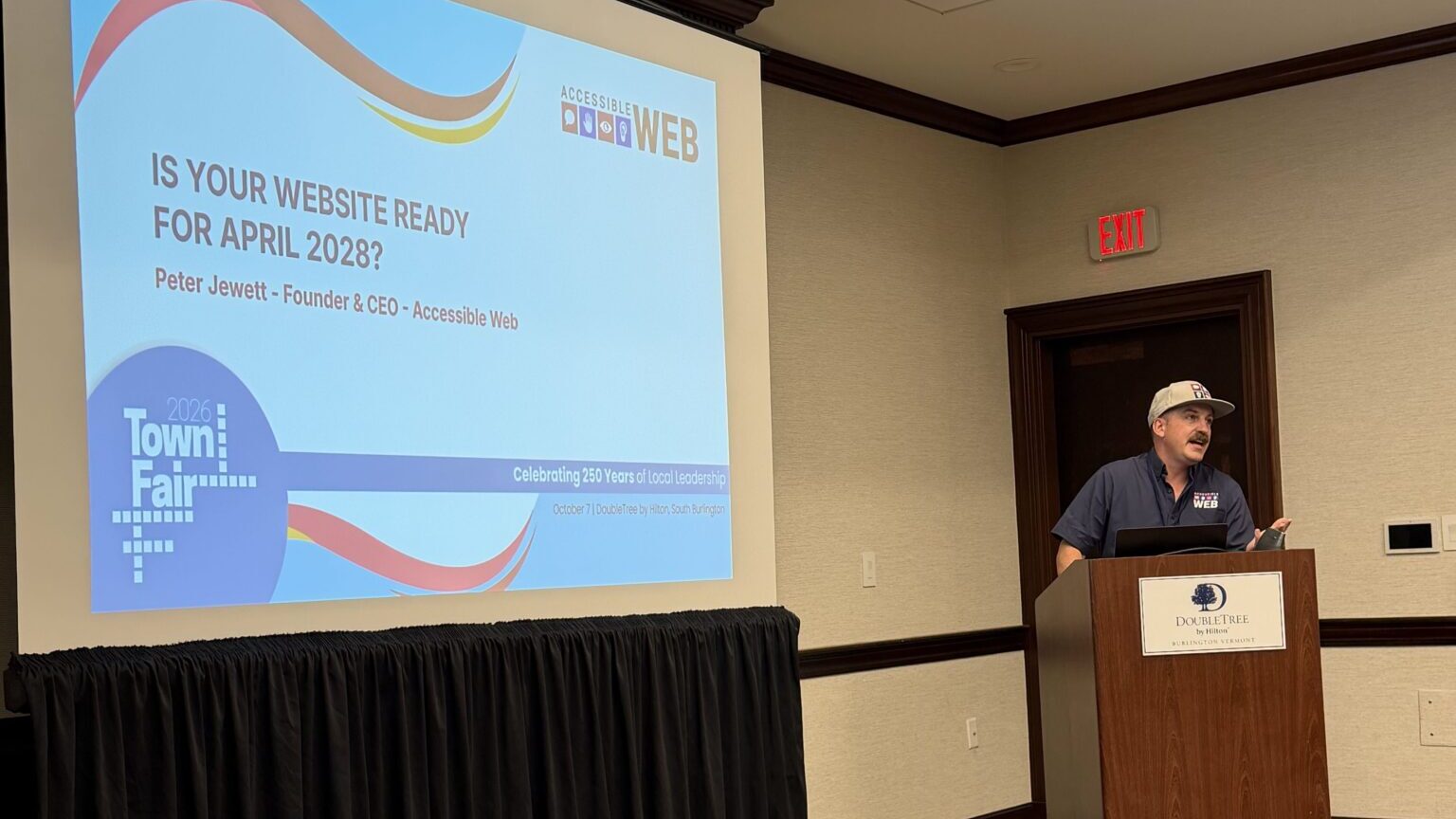
Our session on the ADA Title II deadlines
Peter Jewett, Founder and CEO of Accessible Web, led the afternoon session, Be Ready for New Website Accessibility Requirements. The focus was the Americans with Disabilities Act (ADA) Title II web rule and what it means for Vermont municipalities.
The headline for most towns: the compliance date is April 26, 2028. Earlier this year, the Department of Justice (DOJ) extended the deadline by one year. State and local governments serving 50,000 people or more now have until April 26, 2027. Smaller governments and special district governments have until April 26, 2028, and nearly every Vermont town and city is under that 50,000 line.
The extension didn’t change the standard. Web content and mobile apps still need to meet WCAG 2.1 Level AA, and that includes the vendors who build or manage sites for a town. 2028 can sound far off. For a town website with years of meeting minutes, permit forms, and PDFs, it isn’t.
The session also walked through:
- What WCAG asks for, organized around four principles: perceivable, operable, understandable, and robust.
- Content the rule exempts, including archived web content, older documents no longer in use, and past social media posts.
- What to do when full compliance isn’t feasible by the deadline, such as offering alternative formats, making sure content works with screen readers and other assistive technology, and providing personal help by phone, email, or in person.
Where your town can start
You don’t have to fix everything at once. A few early steps make the next 18 months much more manageable:
- Find out where your website stands. An automated scan is a good first look, but it catches only about 30% to 50% of accessibility barriers, so plan for manual testing too.
- Talk to your vendors early. If someone else builds or hosts your site, forms, or payment portal, ask how they’re meeting WCAG 2.1 AA.
- Publish an accessibility policy that states your commitment, names who is responsible, and explains how issues get addressed.
- Give residents a clear way to report a barrier or request an accommodation by email, phone, or an online form.
- Train the staff who post content. The people uploading agendas and PDFs shape your site’s accessibility as much as your web developer does.
- Keep records of your testing, fixes, and training as you go.
Thank you, VLCT
Thank you to VLCT for having us, and to everyone who stopped by the booth or joined the session. We’re excited to keep the conversation going and to help Vermont communities make their websites and digital services usable for everyone!
If your town is starting to plan for 2028, our ADA Title II compliance playbook lays out the deadlines, requirements, and exceptions in one place. When you’re ready to dig in, Accessible Web RAMP builds a personalized roadmap towards compliance with the accessibility laws that apply to you, helps you find violations, organize remediation tasks, and track your progress over time.
