The new WCAG 3.0 draft is out. Here’s what changed
On September 10, 2026, the W3C published a new working draft of the Web Content Accessibility Guidelines (WCAG) 3.0, the next generation of the standard most accessibility work is measured against today. Nothing in it is enforceable yet. It’s still a working draft, and the W3C is actively collecting comments before anything gets locked in. But it’s worth five minutes of your attention, because it tells you where the baseline is heading.
A different way of organizing requirements
WCAG 3.0 sorts requirements into three types instead of the familiar Level A, AA, and AAA. Core requirements are what any conformance claim has to meet. Supplemental requirements go beyond that baseline. Assertions are different again: instead of a pass-or-fail test, an organization documents a policy or process it follows, such as a style guide for captions or a record of usability testing with people who use screen readers.
That structure matters because WCAG 2.x AAA has always been the tier almost nobody builds to. It’s optional even for organizations that take accessibility seriously. This draft moves several of those AAA-only provisions into the core tier: mandatory, not aspirational.
What’s showing up as core now
A few examples worth knowing if you publish content regularly:
- Transcripts for audio and video content, not just captions.
- Audio descriptions that cover what a video shows but never says out loud.
- A plain-language explanation the first time an abbreviation appears, unless it’s one like “HTML” that’s become a word in its own right.
- A findable summary near the top of any long article.
None of that was ever required to meet WCAG 2.x AA, the standard most laws reference. In this draft, it reads as the floor, not the extra credit.
The list keeps growing, version after version
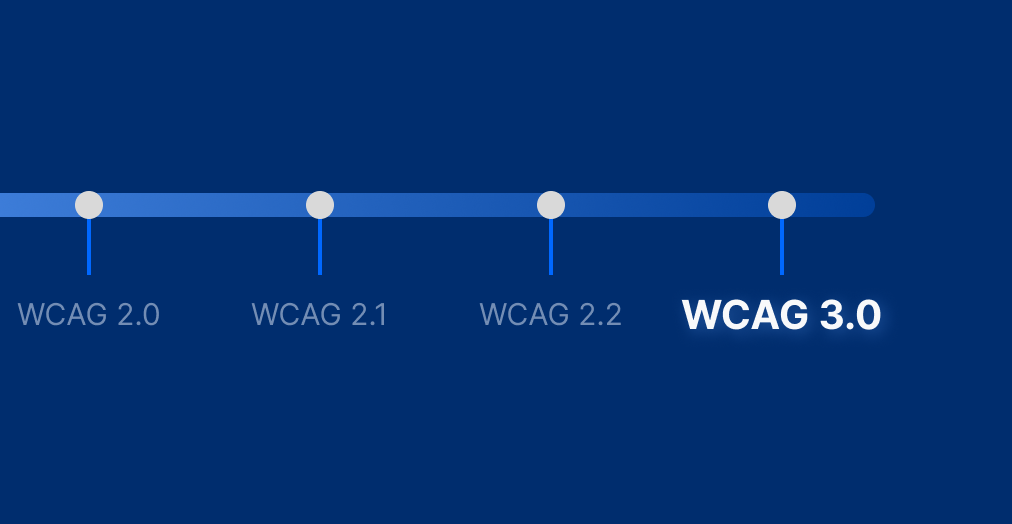
WCAG 2.0 shipped with 61 success criteria in 2008. WCAG 2.1 brought that to 78 in 2018. WCAG 2.2 reached 86 in 2023. Every version has asked for more than the last, and the working group has been direct that this draft’s requirement list will still change: items will be added, combined, and cut before WCAG 3.0 is finalized, which the W3C expects to take several more years.
What this doesn’t change today
If your organization is a Title II public entity under the Americans with Disabilities Act (ADA), the enforceable standard is still WCAG 2.1 Level AA, with compliance deadlines of April 26, 2027, for public entities serving 50,000 people or more, and April 26, 2028, for smaller entities and special districts. WCAG 3.0 does not replace WCAG 2.1 or WCAG 2.2 on any timeline that affects those dates, and the W3C has said that it won’t deprecate WCAG 2.x when 3.0 eventually ships.
What’s worth doing now
- Check whether your video content already has transcripts and audio descriptions, not just captions.
- Check whether the first use of an acronym like Certified Professional in Accessibility Core Competencies (CPACC) or International Association of Accessibility Professionals (IAAP) is actually spelled out on the page.
- Check whether your longer posts and guides give a reader a summary before asking for a few thousand words of their attention.
None of that is new advice. WCAG 3.0 is just making the case that it shouldn’t be optional. If you want a hand keeping track of where your own content stands against where the standard is heading, that’s exactly the kind of ongoing work Accessible Web RAMP helps you organize and monitor over time.
The draft itself is public and open for comment through GitHub or by email to the working group
Curious where your own site stands against a baseline like this? Accessible Web RAMP keeps tracking the basics, missing alt text, caption gaps, overdue remediation tasks, so you always know where you stand instead of finding out only when the next version of WCAG lands.
