Why Am I Being Asked for a VPAT?
If you sell software, incuding digital platforms, or technological services, you may have recently been asked to provide a VPAT. Not sure what that means? You’re in the right spot.
Understanding what a VPAT is, who needs one, how to read one, and how VPATs benefit businesses and people alike can turn what feels like a compliance hassle into a business advantage.
What is a VPAT? What’s an ACR?
A VPAT (Voluntary Product Accessibility Template) is a standardized document that outlines the accessibility status of an Information and communications technology (ICT). It measures conformance against recognized accessibility standards, like the Web Content Accessibility Guidelines (WCAG)
“Voluntary” is a bit of a misnomer. VPATs are often required as part of procurement processes.
In short, VPATs help potential buyers assess accessibility status and risk before buying your product.
ACRs, on the other hand, stand for Accessibility Conformance Reports. They’re the general name for any document that outlines how accessible a product is. That means VPATs are a form of ACR, and as VPATs grow into the industry standard the terms have become more interchangeable.
People assume VPATs are required after the product is fully accessible. But VPATs are a report, not a certification of accessibility.
What Industries Need a VPAT?
Requests for VPATs are most common in industries with stricter legal accessibility obligations. Regulations in the United States require products that serve the public must be complicant with Section 508. Other laws and regulations may apply based on your industry, what you sell, and where you’re located. Unsure which apply to you? Accessible Web’s Compliance Center helps you find out which regulations apply to you.
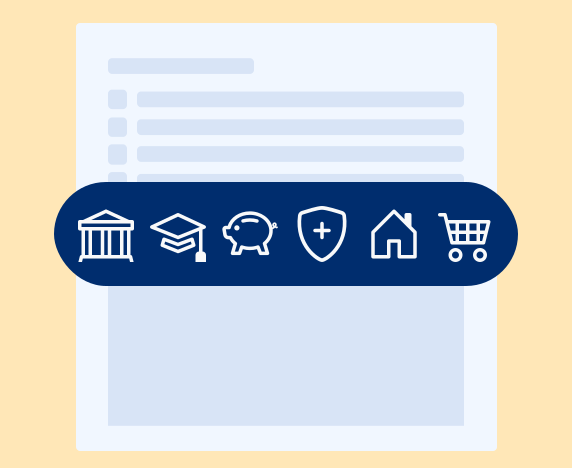
Industries most likely to require a VPAT include but are not limited to:
- Government entities, from local to federal
- Education
- Healthcare
- Financial Services
- E-commerce businesses
- SaaS companies
How do I read a VPAT?
VPATs should have the following:
The Basics
- The evaluated accessibility standard. Most commonly this will be WCAG 2.1 or WCAG 2.2
- Basic product details such as name, version, platform, and date
- Evaluation methods used which should include automated testing, manual testing, and assistive technology testing
Don’t forget to check if the VPAT is recent (we recommend a yearly or bi-yearly VPAT), specific to the product, and, well, completed.
Conformance Status Levels
For each criteria you should see one of the following:
- Supports: The product fully meets the requirement
- Partially Supports: Some aspects meet the requirement, others do not
- Does Not Support: Requirement not met
- Not Applicable: The requirement doesn’t apply to the product
- Not Evaluated: The vendor did not test this criterion
VPATs should also offer context or specifics in the explanation column. This is not a pass/fail document, it’s a proof of current status document, so missing explanations might be a sign of a poorly done VPAT. The highest-quality VPATs include roadmaps, proof of migitation efforts, and other signs that the vendor takes accessibility seriously.
Read our guide on procurement for more information on identifying if a products VPAT is solid.
Can VPATs improve my business?
Even when VPAT needs are intially triggered by compliance goals, they still have business value.
Clients report that VPATs can:
- Unlock more deals by removing a common procurement blocker
- Shorten sales cycles with organizations working in the public sphere, such as government, and education buyers
- Improve product quality through better usability for all users since a good VPAT shows you where you need to improve
- Reduce legal and brand risk by proactively addressing accessibility gaps
If you’re being asked for a VPAT, it’s proof your buyers care about accessibility. Think of it as an opportunity to strengthen your product and expand your market!
Ready to book a VPAT? We’re ready when you are.
